The 3pm slump is costing your business more than you think
It's 3pm. Half your team has glazed over and the other half is refreshing their inbox hoping something interesting happens. Here's what that's actually costing you, and what Adelaide businesses are doing about it.

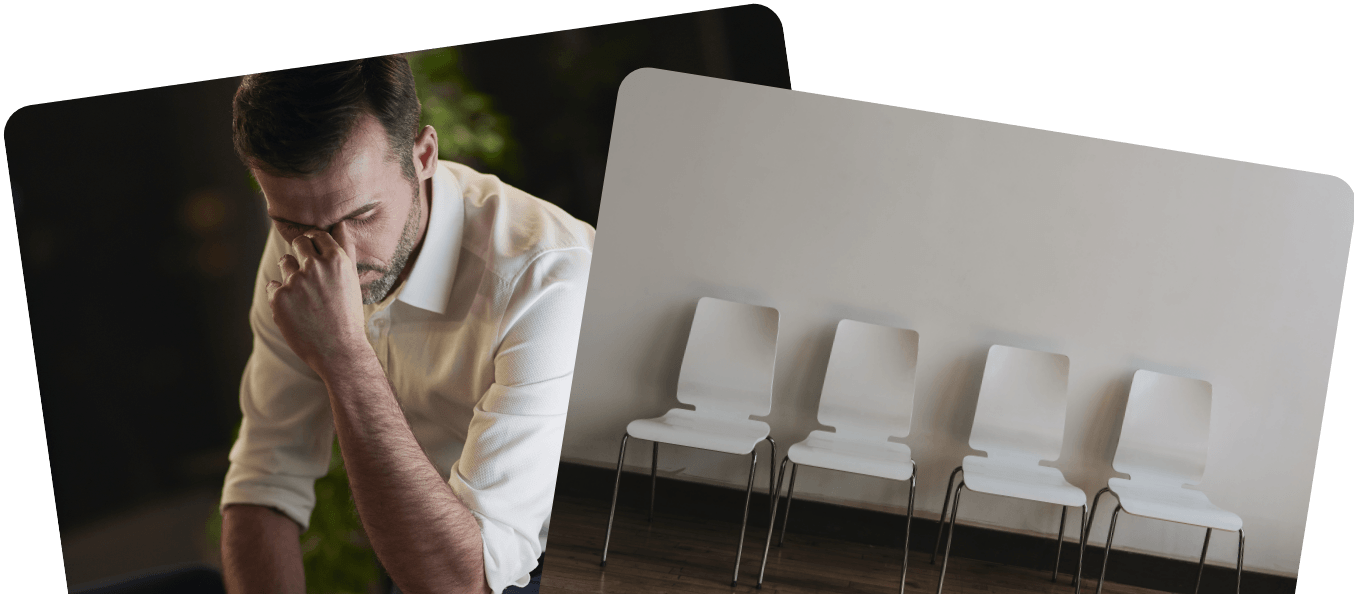
There's a moment in most Australian workplaces that happens like clockwork. It's somewhere between 2:30 and 3:30pm. The emails slow. The replies get shorter. Someone puts the kettle on for the third time. A few people are physically at their desks but mentally somewhere else entirely.
You know the moment. Your team knows the moment. And if you've ever sat in a 3pm meeting and watched six people try not to blink too slowly, you know exactly how productive that hour is.
Here's what most managers don't know: that moment has a price tag.
What's actually happening at 3pm
The afternoon slump isn't a motivation problem or a discipline problem. It's biology.
Your team's circadian rhythm, the internal clock that governs alertness and fatigue, produces a natural dip in energy between 2pm and 5pm. This is the same rhythm that causes peak sleepiness between 2am and 4am. In the afternoon, your body interprets that dip as a signal to slow down. Heart rate drops slightly. Melatonin nudges upward. Cognitive processing slows.
According to a global survey of more than 10,000 desk workers by Slack and Qualtrics, 71% of workers agree that late afternoon is the worst time for work, with productivity plummeting between 3 and 6pm.
That's not 71% of your underperformers. That's 71% of knowledge workers across every industry and every role.
Now multiply that by your headcount.

The presenteeism problem behind the slump
The 3pm slump is the most visible version of a much larger problem: presenteeism. Employees who are physically at work but not functioning at full capacity. Present but not productive.
Presenteeism costs Australian businesses $35 billion a year. That figure dwarfs absenteeism. When employees are absent, at least you know about it and can plan accordingly. When they're present but mentally checked out, the cost is invisible and ongoing.
Safe Work Australia research estimates the total cost of poor psychosocial safety to Australian employers at $6 billion per year, with depression alone costing $6.3 billion annually through presenteeism and absenteeism. In 2025, 37% of Australian employees reported practicing presenteeism during a single quarter, working while unwell or disengaged.
The 3pm slump is presenteeism in its most predictable, most preventable form.
What it looks like in dollar terms for an Adelaide business
Run these numbers for your team. It's confronting.
Take a team of 20 employees. Average salary of $75,000, which comes to roughly $37 per hour. If each employee is operating at 60% capacity for 90 minutes each afternoon, that's the equivalent of 13.5 hours of paid-for-but-not-delivered productivity per day, across the team.
At $37 per hour, that's $499 a day. Across a 250-day working year, it's $124,750. For a team of 20.
If your team is larger or better paid, the numbers climb quickly. And this calculation doesn't account for errors made during low-focus periods, decisions deferred to tomorrow, client interactions that land flat, or the creative work that simply doesn't happen when no-one has the cognitive headspace for it.
The full picture of what stress and fatigue are costing your business is on The Impact page. The number is rarely what people expect.
Why the standard fixes don't work
The usual responses to the 3pm slump: more coffee, step challenges, a fruit bowl in the kitchen. These are fine. They're also not addressing the cause.
Caffeine works temporarily but accelerates the crash that follows. A fruit bowl doesn't reduce cortisol. A step challenge doesn't shift the parasympathetic nervous system into recovery mode.
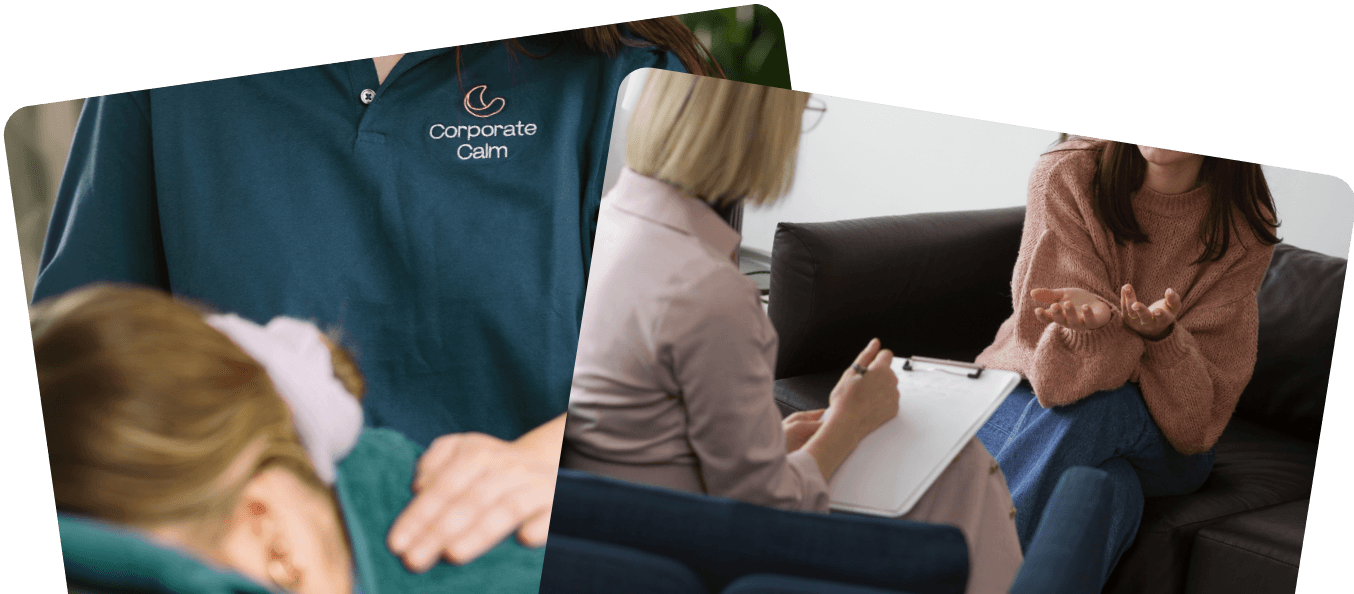
What the research actually shows is that brief physical interventions during the afternoon produce measurable changes in cognitive performance. Studies from the Touch Research Institute at the University of Miami found that a 15-minute chair massage improved maths computation speed and accuracy immediately afterwards, compared to a control group who simply rested. The mechanism: massage reduces cortisol by 31%, increases dopamine by 31% and serotonin by 28%, shifting the brain from depleted to alert. Field et al.'s meta-review confirmed these changes are measurable within a single session.
Your team doesn't need to rest through the 3pm slump. They need a physiological reset. There's a meaningful difference.
What Adelaide workplaces are doing about it
Corporate Calm is Adelaide-based, which means we understand the rhythms of Adelaide workplaces: the EOFY pressure in Grenfell Street accounting firms, the afternoon call volume in Adelaide's contact centres, the sprint cycles in tech businesses along the Lot Fourteen corridor.
The most common booking pattern for Adelaide businesses using on-site massage is a fortnightly afternoon session, scheduled to land specifically in the 2:30 to 3:30pm window. Employees rotate through in 15-minute slots. The cost is around $15 to $20 per person per session. By the time the session ends, the people who've been through are measurably more focused for the remaining two hours of the day.
For Adelaide businesses wanting to move further than a single intervention, our workplace massage service can be structured around your peak fatigue windows, your team's size and your budget.
For the practical side, our 3pm Slump Survival Kit has 15 evidence-backed tactics for the rest of the afternoon, the ones that actually move the needle.
And if you want a number for what regular sessions would cost for your Adelaide team: our instant quote calculator gives you a figure in under two minutes.
Your team is giving you their afternoons. The least you can do is give them something that works.

References
¹ Slack and Qualtrics. "State of Work: Global Survey of 10,000 Desk Workers," 2023. Cited via CNBC. https://www.cnbc.com/2023/12/14/the-worst-time-of-day-to-be-productive-according-to-new-slack-research.html
² Scalesuite. "Australian Workplace Absenteeism and Presenteeism Statistics 2026." https://www.scalesuite.com.au/resources/australian-workplace-absenteeism-and-presenteeism-statistics
³ Safe Work Australia. "Psychosocial safety climate and better productivity in Australian workplaces." https://www.safeworkaustralia.gov.au/resources-and-publications/reports/psychosocial-safety-climate-and-better-productivity-australian-workplaces-costs-productivity-presenteeism-absenteeism
⁴ Field T et al. "Cortisol decreases and serotonin and dopamine increase following massage therapy." International Journal of Neuroscience, 2005. https://pubmed.ncbi.nlm.nih.gov/16162447/
⁵ Field T et al. "Massage therapy effects: EEG alertness and maths computations." Touch Research Institute, 1998. https://pubmed.ncbi.nlm.nih.gov/8884390/
⁶ Comcare. "Benefits to business: the evidence for investing in worker health and wellbeing." https://www.comcare.gov.au/__data/assets/pdf_file/0006/99303/Benefits_to_business_the_evidence_for_investing_in_worker_health_and_wellbeing.pdf