Why your EAP isn't a wellness program
80% of Australia's top 500 companies offer an EAP. The average utilisation rate? Five percent. Here's why that number should worry you and what actually works instead.

Here's a number that should make every HR manager uncomfortable. The average utilisation rate for Employee Assistance Programs across Australia sits at around 5%. In retail, construction and manufacturing, it drops to as low as 2%.
That means for every 100 employees you're covering, somewhere between two and five will actually use the service you're paying for. The other 95 either don't know about it, don't trust it, or don't think it applies to them.
And yet, when someone asks "what are you doing about employee wellbeing?", the answer is almost always "we have an EAP."
That's not a wellness program. That's a checkbox.
The numbers are worse than you think
80% of Australia's top 500 companies offer an EAP. The industry generates $380 million annually in Australia alone. These are well-funded, widely available programs.
So why aren't people using them?
Research from Sonder and PwC Australia identified three core reasons. First, EAPs aren't built into workplace culture. Major barriers exist, from a lack of awareness about what's available to persistent stigma around accessing mental health support. Second, the solutions aren't fit for purpose. Most EAPs take a one-size-fits-all approach focused on crisis support rather than prevention. Third, poor past experiences. Concerns about quality of care, privacy and delays in receiving support mean many employees avoid engaging altogether.
In some Australian healthcare settings, utilisation has been reported as low as 0-4%, with researchers citing a lack of transparency and availability as key barriers.
The pattern is clear. These programs are designed for people in crisis. The problem is that by the time someone is in crisis, you've already lost weeks or months of productivity, and possibly the employee entirely.

Why EAPs fail as wellness programs
EAPs were never designed to be wellness programs. They originated in the 1940s as workplace alcohol management tools in the United States. They've evolved since then, but their fundamental architecture hasn't changed. They're reactive. They wait for someone to reach out, identify themselves as struggling, navigate a booking system, and show up to an appointment with a stranger.
Every one of those steps is a barrier.
The employee has to admit they need help. In workplaces where "she'll be right" is the default culture, that's already a non-starter for most people. They have to trust that it's genuinely confidential and won't affect their career. Research shows that fear of stigma and concerns about confidentiality are consistently identified as barriers to use. Men are particularly low users, and in industries like construction, manufacturing and IT, that's a significant portion of the workforce.
Then there's the practical side. Even motivated employees face wait times, limited session allocations (typically 2-6 sessions), and the logistical challenge of scheduling appointments around work. By the time the process is complete, many have either resolved the issue themselves, left the company, or simply given up.
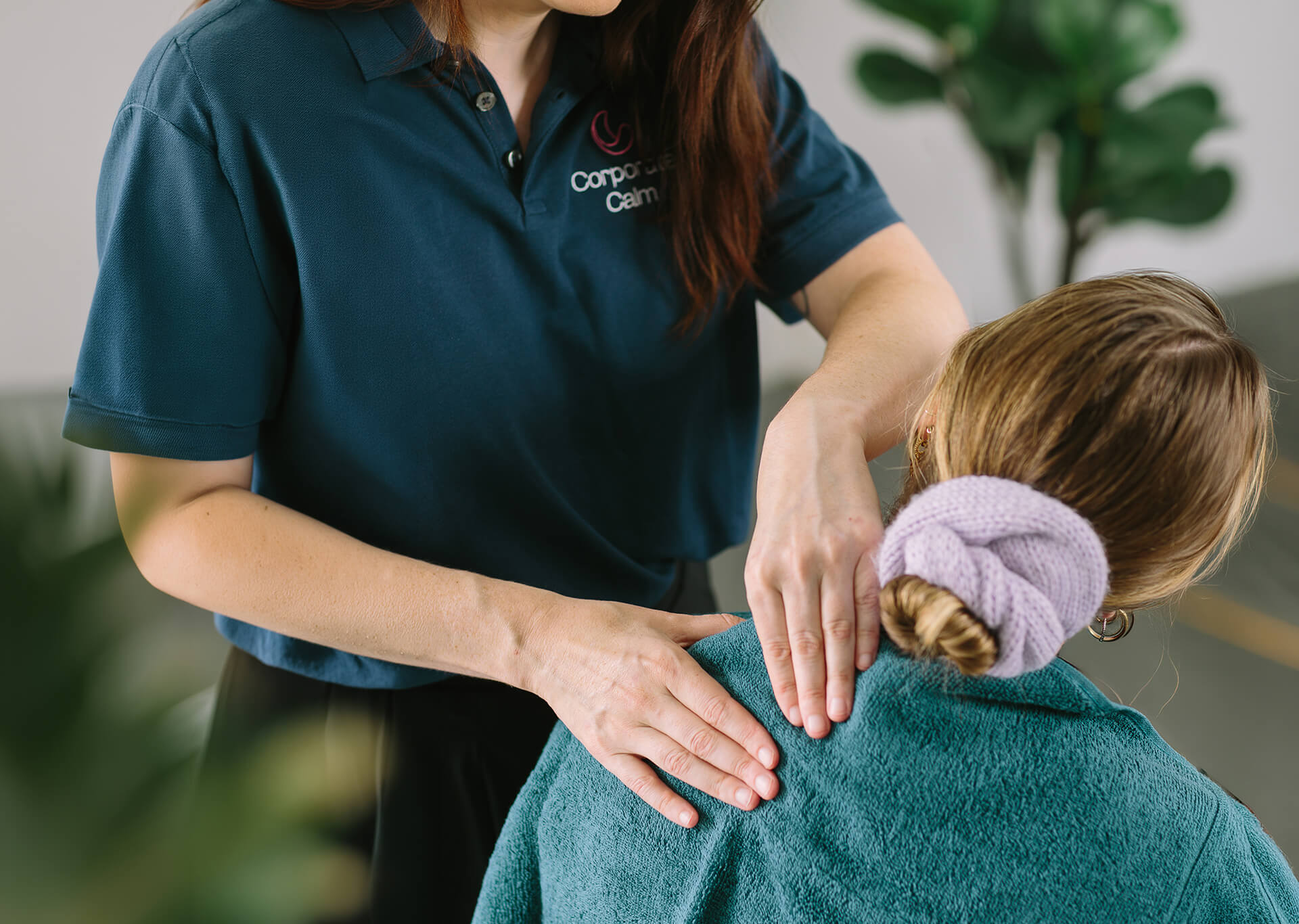
Compare that to offering massage for employees in the office. No self-identification required. No booking a separate appointment. No stigma. No disclosure. You sit in a chair for 15 minutes, fully clothed, during your work day. The therapist comes to you. Participation rates for on-site massage at work consistently hit 99%.
The difference isn't about which intervention is "better." It's about which one people actually use.
The participation gap tells you everything
This is the number that should reframe the entire conversation. When you offer an EAP, 5% of employees engage. When you offer massage for staff at work, 99% participate.
That's not a small difference. That's the difference between a program that exists on paper and a program that exists in practice.
And participation matters because it's the prerequisite for every other outcome. You can't reduce sick leave if nobody uses the service. You can't improve retention if 95% of your workforce doesn't engage. You can't demonstrate ROI to your CFO if the utilisation report shows single digits.
The interventions that work at scale share common characteristics. They're proactive rather than reactive. They come to the employee rather than requiring the employee to seek them out. They require zero disclosure about personal circumstances. They're visible, normalised and universal rather than hidden, stigmatised and individual. And they deliver immediate, tangible results that employees can feel, not just measure.
EAPs fail most of these tests. Office massage passes all of them.
This isn't an argument against EAPs
Let's be clear about what we're saying and what we're not.
EAPs serve an important function. For the 5% of employees who do use them, the support can be genuinely valuable. Crisis counselling, legal advice, financial guidance and substance abuse support are legitimate services that some employees need.
The argument isn't that you should cancel your EAP. The argument is that you should stop pretending it's a wellness program. An EAP is a safety net for people in crisis. A wellness program is a proactive strategy that reaches your entire workforce before crisis occurs.
If your entire wellbeing strategy is an EAP with a 5% utilisation rate, you've got a plan for 5% of your people. The other 95% are on their own. They're managing stress, absorbing workplace pressure and carrying physical tension without any support at all. Eventually some of them will end up using the EAP. But by then, the damage to their health, their productivity and potentially their employment is already done.
What a real wellness strategy looks like
A real wellness program has layers. It addresses the whole workforce, not just the people willing to raise their hand and ask for help.
The base layer is physical. Regular massage for employees, movement breaks and ergonomic support. This is the layer that reaches everyone because it requires nothing from the employee except showing up. It's visible, it's normalised, and it sends a clear signal: we care about your wellbeing before you're in crisis, not after.
The middle layer is environmental. Workload management, manager training, flexible scheduling and psychosocial risk assessment. This is the layer that addresses the root causes of stress rather than treating the symptoms.
The top layer is individual support. EAPs, counselling access, mental health first aiders. This is the layer for people who need targeted, professional support beyond what a wellness program can provide.
Most organisations have the top layer and nothing else. They've built a safety net but forgot to build the floor.
The question to ask your leadership team
Next time someone says "we have an EAP" as the answer to employee wellbeing, ask one question: what's our utilisation rate?
If it's 5%, you know that 95% of your workforce isn't being supported by your current approach. That's not a wellbeing strategy. That's a liability with a brochure.
The organisations getting this right are the ones layering proactive, physical wellness underneath their existing support. They're offering on-site massage for their employees and reaching the entire workforce, not waiting for the 5% to put their hand up.
Your team is stressed now. Not in crisis, not at breaking point, but carrying enough tension that it shows up in sick days, productivity dips and that resignation letter sitting in someone's drafts folder.
The EAP won't reach them. But 15 minutes in a chair might.
Ready to reach the other 95%?
See how office massage works or grab our free 3pm Slump Survival Kit for 15 ways to fix workplace exhaustion without an app nobody downloads.