The high-stress industries that get the most out of workplace massage
Some industries don't just benefit from workplace massage. They desperately need it. Here are the five high-stress sectors where on-site massage delivers the biggest impact on burnout, retention and sick leave.

Not every workplace carries the same weight. Some industries operate at a level of sustained pressure that makes burnout less of a risk and more of an inevitability. The kind of pressure that turns good people into resignation statistics and transforms Monday mornings into something approaching dread.
These are the industries where workplace massage doesn't just make a nice perk. It makes a measurable difference to retention, sick leave and the daily physical toll that accumulates in people's shoulders, necks and lower backs without anyone noticing until it's too late.
We work with businesses across high-stress sectors in Australia, and the patterns are remarkably consistent. Different industries, different job titles, different pressures. But the same tight shoulders, the same escalating absenteeism, and the same quiet relief when someone finally does something tangible about it.
Here are the five industries where on-site massage consistently delivers the biggest returns.
Call centres: where the pressure never stops ringing
Call centre work is relentless in a way that's difficult to appreciate from the outside. Agents aren't just answering phones. They're absorbing anger, frustration and distress from strangers for hours at a stretch, while a screen tracks their every metric in real time.
Average handling time. First-call resolution. Customer satisfaction scores. All measured, all visible, all adding a layer of performance anxiety on top of the emotional toll of the calls themselves.
The physical consequences are just as brutal. Headset strain creates chronic tension through the neck and shoulders. Hours of sitting in the same position leads to lower back pain and postural issues. Repetitive keyboard and mouse work drives strain through the wrists and forearms. And because call centre environments are often open-plan and tightly scheduled, there's nowhere to decompress between difficult calls.
The numbers tell the story. Australian contact centre data from ACXPA puts average annual attrition at approximately 29% in 2025, up from 27% the previous year, with average absenteeism at 11.3%. Aon research found that on average 45% of call centre staff leave their job every year, with the average tenure for frontline staff sitting at just 22 months.
Every time an agent walks out, the cost of recruiting, onboarding and training their replacement lands squarely on the business. And the agents who stay carry the extra load until backfill arrives, which accelerates burnout in the people you can least afford to lose.
This is where massage for employees makes an outsized impact. A 15-minute chair massage between shifts directly addresses the headset tension, the postural strain and the accumulated stress that call centre agents carry physically. It requires nothing from the agent except sitting down. No app to download. No workshop to attend. No self-disclosure. Just someone skilled working on the exact spots where the job leaves its mark.
And participation rates reflect it. Traditional wellness programs see median uptake of just 20% without incentives, according to RAND Corporation research. On-site massage programs consistently achieve 90% or higher, because the barrier to entry is essentially zero.
If you manage a call centre and turnover is eating your budget, our call centre industry page breaks down exactly how workplace massage fits into your environment.

IT and MSP providers: always on, always burning out
IT support and managed service provider work operates under a particular kind of pressure that never fully switches off. When a client's system goes down, the clock starts immediately. SLA timers don't care that it's 11pm or that your team has already handled six escalations today.
The stress profile in IT support is different from developer burnout, although the physical consequences overlap. Support staff deal with angry clients, urgent tickets, complex troubleshooting under time pressure and the constant background hum of knowing that the next emergency could arrive at any moment. After-hours callouts disrupt sleep patterns. The sedentary nature of the work, hours at a desk staring at multiple monitors, compounds the physical toll.
Recent Australian data from Sophos found that IT and cybersecurity workers are now losing 4.8 hours per week to stress and burnout, a 26% increase on the 3.8 hours reported the previous year. Almost 80% of surveyed organisations reported experiencing cybersecurity-related stress or burnout. And one in five said they experienced it frequently rather than occasionally.
The TELUS Health Mental Health Barometer found that 47% of Australian workers feel exhausted every single day. In IT environments, where after-hours work is normalised and the boundary between work and personal time is paper-thin, that figure is likely conservative.
Most IT companies and MSPs have nothing in place for employee wellbeing. No EAP, no gym membership, no structured support of any kind. Workplace massage fills a gap that most of these businesses don't even realise exists until someone senior burns out and hands in their notice.
The physical benefits are immediate and specific. Massage at work directly targets the upper back tension from hunching over keyboards, the neck strain from toggling between monitors, the shoulder tightness from cradling a phone, and the lower back pain that builds invisibly across months of desk-bound work. Research from Day et al. demonstrated that workplace massage significantly reduces both strain and blood pressure compared to control groups.
For IT businesses specifically, our IT and MSP industry page covers how on-site massage works around support schedules, shift patterns and the unpredictable nature of IT work.

Tech and software companies: the talent war's quiet casualty
Tech companies have a different problem. The stress is intense but it comes wrapped in perks. Ping pong tables. Craft beer. Flexible hours that somehow always flex in the direction of more work. The culture looks great from the outside, and it photographs beautifully for the careers page, but the burnout underneath is real and accelerating.
Developers face sprint pressure, constant context-switching, unrealistic deadlines and the particular exhaustion of deep cognitive work interrupted by meetings that could have been emails. Haystack Analytics research found that 83% of software engineers reported suffering from burnout, with the primary driver being unrealistic timescales and the incorrect use of productivity metrics.
The talent competition makes retention existential. Mid-tier tech companies can't match the salaries offered by major players, so culture and wellbeing become the only real differentiator. And when your developers are getting LinkedIn messages from recruiters every week, the perks you offer need to deliver something your team actually feels, not just something that looks good in a job listing.
This is where corporate massage earns its place in the tech stack. Unlike a ping pong table that gathers dust or a meditation app that nobody downloads, massage for staff delivers a tangible physical benefit that people notice immediately and talk about afterwards. It's the kind of perk that shows up in Glassdoor reviews and gets mentioned in stay interviews. It requires zero effort from the developer and takes 15 minutes out of a sprint day, returning someone who's measurably less tense and more focused.
Australian Government data from Comcare found that workplace wellness programs reduce sick leave by 25.3%, lower workers compensation costs by 40.7% and deliver $5.81 for every $1 invested. In a tech company where a senior developer's departure can cost six figures in lost productivity and replacement costs, those numbers move fast.
Our tech and software industry page goes deeper into how workplace massage gives mid-tier tech companies an edge in the talent war.

Employment services: the weight of other people's trauma
Employment services is the sector nobody talks about when they talk about high-stress workplaces. But the people working in Workforce Australia sites, jobactive providers and employment support services carry a psychological load that rivals frontline healthcare.
Consultants spend their days working with people who are often in crisis. Long-term unemployment, homelessness, domestic violence, addiction, mental health conditions. The stories these workers absorb don't stay in the consultation room. They accumulate in the body as secondary trauma, which over time produces the same physiological stress responses as direct trauma: elevated cortisol, disrupted sleep, chronic muscle tension, emotional exhaustion.
Research published in Australian Social Work found that mental health social workers experience burnout manifesting as physical sickness, "busyness addiction" and a collapse of work-life boundaries. Community services workers working as their primary employer report feeling emotionally drained and under pressure due to understaffing. The mental health sector has been ranked as the second most emotionally demanding field to work in, after police work.
Safe Work Australia data shows that exposure to violence and harassment accounts for 15.7% of serious mental health claims, while work pressure drives 24.2%. Employment services workers face both: the emotional weight of their caseloads and the government KPIs that measure everything except the toll on the people delivering the outcomes.
For these workers, workplace massage offers something that other interventions struggle to deliver. It's physical. It requires no talking, no disclosure, no emotional labour. In a profession where the entire day involves listening to other people's pain, the chance to sit down for 15 minutes and have someone take care of them, without asking anything in return, is genuinely restorative.
Field et al.'s meta-review found that massage reduces cortisol by an average of 31% while increasing serotonin by 28% and dopamine by 31%. For workers running on empty from secondary trauma exposure, that neurochemical shift isn't a luxury. It's a circuit breaker.
Our employment services industry page covers how on-site massage works around client appointment schedules and the specific compliance considerations that matter in government-funded environments.

Finance and accounting: deadline-driven to breaking point
Finance and accounting professionals operate in an environment where the pressure is cyclical but the baseline never really drops. Tax season. End of financial year. Audit periods. Quarterly reporting. Each deadline brings its own intensity, and the gaps between them have shrunk as regulatory requirements and client expectations have expanded.
The work is sedentary, cognitively demanding and high-stakes. Errors carry real consequences: regulatory penalties, client losses, reputational damage. That combination of responsibility and precision, sustained over long hours in a chair, produces a physical profile that's strikingly consistent: locked-up shoulders, compressed lower backs, tension headaches from screen fatigue and the kind of chronic low-grade stress that doesn't announce itself until it arrives as a sick day or a resignation.
Robert Half's survey of 1,000 Australian office workers found that four in five were experiencing some level of burnout, with heavy workloads and insufficient staffing identified as the top two drivers. Beyond Blue found that inappropriate workload is the single largest driver of burnout in Australian workplaces at 49%.
Finance teams often have the least wellness infrastructure of any corporate function. They're the ones scrutinising everyone else's wellness budgets, which creates an ironic blindspot: the people who approve the spend are often the last to receive any benefit from it.
Office massage fits finance environments particularly well. Sessions are short, scheduled and don't require anyone to leave the building or change clothes. They can be timed around reporting deadlines, rotating through the team without disrupting workflow. And because the physical benefits are immediate, even the most sceptical partner or CFO notices the difference in their neck after 15 minutes.
The American Massage Therapy Association reports that blood pressure, oxygen consumption and salivary cortisol all drop measurably after just 10 to 15 minutes of chair massage. For a profession where the physical toll is invisible until it becomes a problem, that kind of targeted intervention is exactly what's needed.

Why workplace massage works where other wellness fails
There's a reason these five industries respond so strongly to on-site massage, and it's the same reason across all of them.
The people working in these environments are already stretched thin. They don't have spare time, spare energy or spare emotional bandwidth for wellness programs that ask them to do more. Download an app. Attend a session. Complete a module. Track their steps. Every one of those asks lands on someone who's already maxed out.
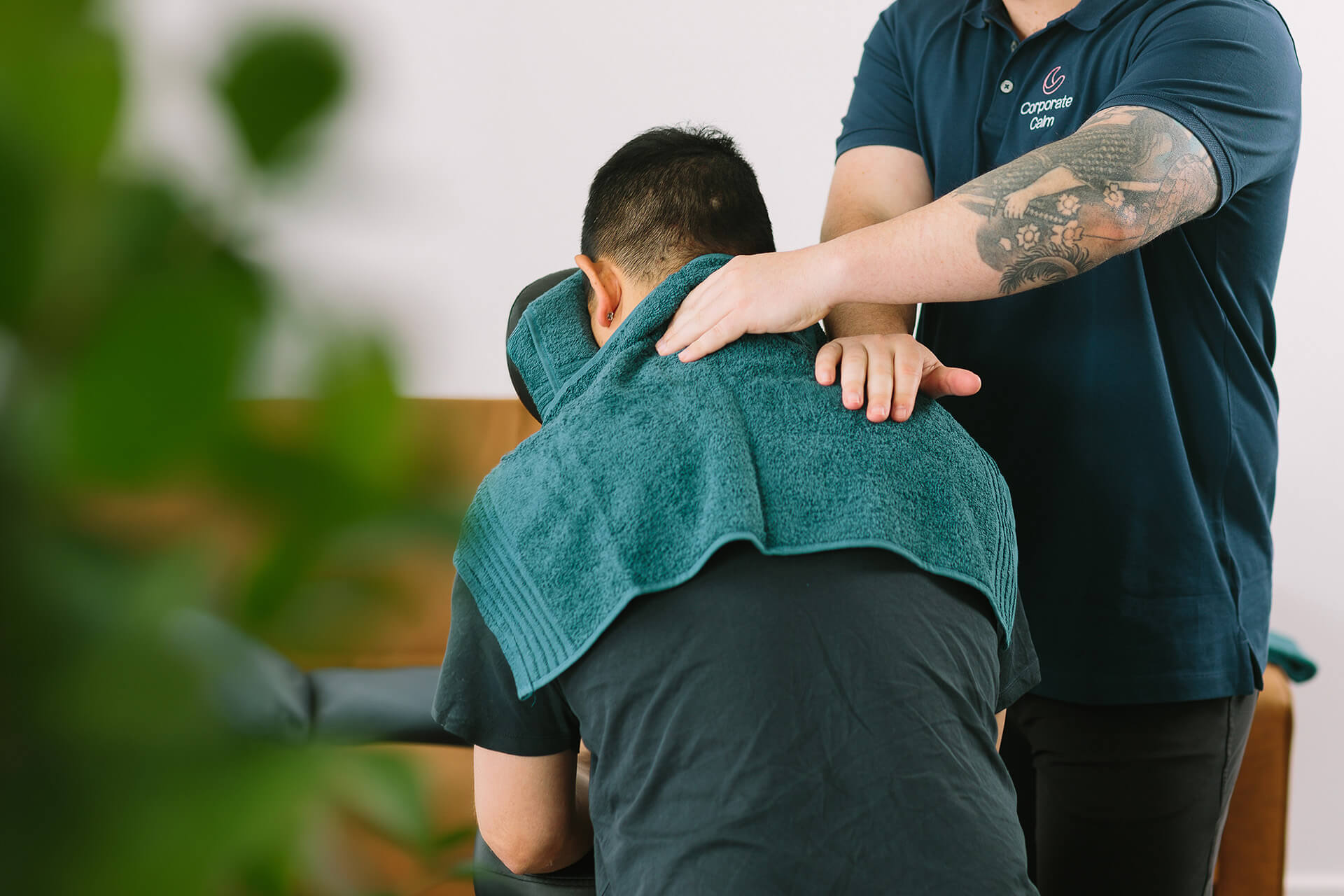
Massage for employees inverts that equation. It brings the benefit to the person. It requires nothing except 15 minutes of sitting still while a professional takes care of the physical tension that's been building for weeks or months. No signup form. No login. No behaviour change. No disclosure.
That's why RAND Corporation research found traditional wellness programs average just 20% participation, while ongoing workplace massage programs consistently see 90% or higher.
It's also why the business case is so strong. Comcare's research shows a return of $5.81 for every $1 invested in workplace wellness, with measurable reductions in sick leave and workers compensation costs. When your industry already has elevated rates of both, the return accelerates.
What this means for your workplace
If your business operates in any of these sectors, the question isn't whether your team is stressed. The data confirms they are. The question is whether you're going to do something tangible about it, or add another app to the intranet.
Workplace massage isn't a silver bullet. It works best alongside structural improvements: reasonable workloads, quality management, genuine flexibility. But it's the fastest way to demonstrate that you actually care about your team's physical and mental wellbeing, in a way they can feel immediately.
No login required. No behaviour change needed. Just 15 minutes of someone giving a damn.
Ready to see what workplace massage looks like for your industry?
Our instant quote calculator gives you a figure in under two minutes. Or explore our workplace massage service to see how it works.