How to set up a workplace massage program your team will actually use
Most workplace wellness programs get 20% participation and quietly disappear. Here's how to set up a workplace massage program that hits 90%+ uptake, runs itself and becomes the thing your team actually looks forward to.
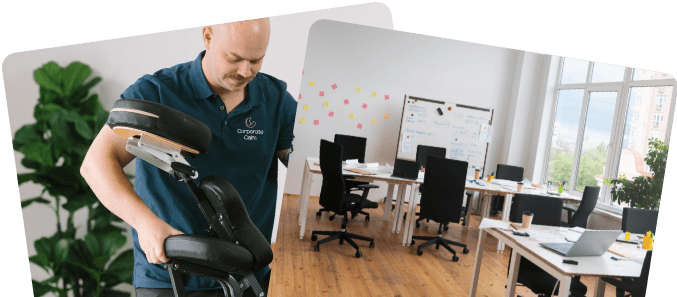
The graveyard of workplace wellness programs is enormous. Meditation apps that got 12 downloads. Step challenges that lasted three weeks. Lunch-and-learn sessions that attracted the same five people every time. Fruit bowls that decomposed quietly in the kitchen while the burnout rate stayed exactly where it was.
If you're reading this, you're probably the person who approved one of those programs. Or you're about to be the person who proposes the next one. Either way, you're asking the right question: how do you set up something your team will actually use?
The answer is simpler than you think. And the reason workplace massage succeeds where most wellness programs fail comes down to one structural difference that changes everything.
Why most wellness programs fail (and why massage doesn't)
RAND Corporation research found that without incentives, the median participation rate for employer wellness programs is just 20%. Even with monetary incentives, that only climbs to 40%. The majority of your workforce never touches most wellness offerings, no matter how well-intentioned they are.
The reason is consistent across the research. Most wellness programs ask employees to do something: download an app, attend a session, change a behaviour, disclose personal information or schedule something outside of work hours. Every one of those asks lands on someone who is already stretched thin, and the participation rate reflects it.
On-site massage inverts that equation entirely. It comes to the employee. It requires no behaviour change, no app, no disclosure and no scheduling outside of work. Someone sits down fully clothed for 15 minutes, a skilled therapist works on the tension they've been carrying since last week, and they go back to their desk. The barrier to participation is essentially zero.
That's why ongoing workplace massage programs consistently achieve participation rates of 90% or higher. Not because massage is inherently better than other forms of wellness. But because the delivery format removes every barrier that kills other programs.
If you want the detailed science of what happens during those 15 minutes, we've written the full breakdown in our post on what workplace massage actually does to your body in 15 minutes.
Step one: work out what you're trying to solve
Before you call a provider or block out a meeting room, get clear on what problem you're trying to address. This isn't about writing a wellness strategy document. It's about being honest about what's happening in your workplace.
Is it absenteeism? If your sick days are climbing, you're looking at a stress and physical health problem. Comcare's research found that workplace wellness programs reduce sick leave by 25.3%. That's your baseline for measuring whether the program is working.
Is it turnover? Beyond Blue found that 40% of Australian employees cite burnout as a reason for resignation. If you're losing people faster than you can replace them, you're looking at a retention problem that massage directly addresses by reducing the daily toll that drives people to the exit.
Is it morale and engagement? If your engagement surveys are flat, your team is showing up but not bringing their energy. Massage is one of the few interventions that produces an immediate, tangible shift in how people feel, which is why it shows up unprompted in engagement survey comments within months of starting.
Is it all three? That's normal. Most workplaces dealing with one of these are dealing with all of them. The good news is that a well-run workplace massage program addresses them simultaneously.
Knowing your starting point also gives you something to measure against. Track your sick days, turnover rate and engagement scores before you start, and compare them at three months and six months. The data will make the case for continuing.

Step two: find the right space
You need less space than you think. A portable massage chair takes up approximately 1.5 square metres. That's about the size of a small desk.
The ideal spot is a quiet room with a door that closes. An unused meeting room, a small office, a section of the break room that can be curtained off. It doesn't need to be a dedicated wellness room. It just needs to be a space where someone can have 15 minutes without being interrupted by phone calls, conversations or the sound of the coffee machine.
If you don't have a spare room, get creative. We've set up in server rooms, storerooms, corners of open-plan offices with portable screens and even outdoor covered areas. The therapist brings everything they need. All you provide is the space and a power point.
The one thing to avoid is putting the massage chair in the middle of a busy, open area where everyone can watch. Some people are self-conscious about being seen getting a massage at work, especially the first time. A semi-private setup removes that barrier and increases uptake from day one.
Step three: choose your frequency
This is where most businesses overthink it. The right frequency depends on your team size, your budget and your goals. Here's a simple guide.
Monthly sessions work well as a starting point, especially if you're testing the concept. They give your team regular access without a large upfront commitment. The downside is that monthly isn't frequent enough to build the cumulative physiological benefits that come from regular massage, but it's enough to demonstrate participation and impact.
Fortnightly sessions are the sweet spot for most businesses. They're frequent enough to build cumulative benefits (each session resets cortisol, serotonin and dopamine, and over time the baseline shifts) while being manageable on most budgets. This is the frequency where massage stops being a special event and starts becoming part of the workplace rhythm.
Weekly sessions are ideal for larger teams or high-stress environments like call centres, IT support or employment services. At this frequency, you can rotate the therapist through the full team each week, and the program becomes a fixed point in the calendar that people plan their week around.
The key insight: start with what you can sustain. A monthly program that runs consistently for 12 months delivers better outcomes than a weekly program that gets cut after three months because the budget wasn't locked in. You can always increase frequency once the results justify it.
Step four: schedule around reality
The logistics of a workplace massage program are simpler than most people expect. A single therapist sees one person every 15 minutes, which means 12-16 people in a half-day session or up to 28-30 in a full day with breaks. For larger teams, multiple therapists can work simultaneously.
Schedule sessions during work hours, not before or after. The whole point is that employees don't need to do anything extra. A slot during the workday means the massage fits into their existing routine rather than competing with their commute or their lunch.
The most popular time slots tend to be mid-morning (between 10 and 12) and mid-afternoon (between 1:30 and 3:30), which aligns with the natural energy dips in the workday when employees benefit most from a reset. Avoid scheduling right at 9am when people are settling in, or after 4pm when people are thinking about leaving.
For the booking system, keep it simple. A shared spreadsheet, a sign-up sheet on the kitchen bench, or the booking system your provider offers. The less friction in the booking process, the higher your uptake. If people have to navigate a complex system or request approval from their manager, participation drops.
One practical tip: book your most sceptical manager into the first session. When they come back looking visibly different, the rest of the team follows./

Step five: choose a provider who handles the logistics
A good workplace massage provider should make your life easier, not harder. They should handle therapist scheduling, equipment, insurance, therapist rotation and the coordination of sessions so that your involvement is minimal after setup.
Things to look for: therapists who are qualified, insured and experienced in workplace settings. A provider who brings their own equipment and doesn't need you to supply anything beyond a room and a power point. Flexible scheduling that adapts to your team's needs. And a provider who understands your industry, because the stress profile of a call centre is different from a tech company, which is different from an employment services provider.
The therapist matters more than most people realise. The best workplace massage therapists learn your team. They remember names, pressure preferences and individual tension patterns. They know who carries stress in their shoulders versus their lower back. They notice when the team's tension has spiked because of a deadline or a difficult week. Over time, they become a quiet part of your team's support structure, and that continuity is what turns a transactional service into something people genuinely value.
Step six: launch it right
The first session sets the tone. A low-key launch works better than a big announcement. Send a brief email or Slack message explaining what's happening, when and where. Keep the language simple and casual. Avoid corporate wellness jargon. Something like "we're bringing in a massage therapist on Tuesday. Sessions are 15 minutes, fully clothed, completely optional. Sign up here."
Don't oversell it. Don't frame it as a "wellness initiative" or a "mental health program." Frame it as what it is: someone's coming to take care of the tension in your neck and shoulders for 15 minutes during the workday.
Make sure the first round of bookings includes a mix of enthusiasts and sceptics. The enthusiasts will come back glowing and telling everyone. The sceptics will convert after their first session and become your strongest advocates. If you want to know what that trajectory typically looks like, our post on what happens after month one of workplace massage walks through the full timeline.
After the first session, collect informal feedback. Did people enjoy it? Was the timing right? Was the space comfortable? Make small adjustments based on what you hear. This isn't a program you set and forget. It's one you refine over the first few sessions until it runs smoothly.
Step seven: measure and protect the budget
This is the step that determines whether your massage program survives its first budget review.
Before you start, capture your baseline metrics: average sick days per employee, turnover rate, and if you have it, engagement survey scores. These are the numbers you'll use to demonstrate ROI at three months and six months.
Comcare's research shows workplace wellness programs return $5.81 for every $1 invested. PwC and Beyond Blue's analysis found a return of $2.30 per $1 invested in workplace mental health. These are the benchmarks you reference when someone asks whether the program is worth continuing.
If you want to build a detailed business case before you start, our free Spreadsheet of Truth calculates the expected ROI based on your team size, average salary and current turnover rate. It's designed to give you numbers you can put in front of a CFO with confidence.
The other metric worth tracking is participation rate. If your massage program is running at 90%+ uptake, that alone tells a story. Compare it to any other wellness initiative you've run and the difference makes the case for you. For the full financial breakdown, our post on the hidden ROI of corporate massage walks through every line item.

What happens next
If you follow these steps, here's what typically happens.
Week one: the sign-up sheet fills. Half the team is curious, a quarter is enthusiastic and a quarter is sceptical. The first people come back to their desks looking different. Someone says "that was actually amazing" loud enough for the holdouts to hear.
Month one: the sceptics have converted. The sign-up sheet fills within hours of going up. Someone has claimed "their" time slot. The therapist knows half the team by name.
Month three: the program sells itself. It shows up in engagement survey comments. Someone in another department asks why they don't have it. The conversation shifts from "is this worth it?" to "can we do this more often?"
That's the trajectory. And it starts with a single decision to try it.
Ready to get started?
Our instant quote calculator gives you a figure in under two minutes. Or explore our workplace massage service to see how we handle all the logistics.