What to expect from your first workplace massage
Your first workplace massage is 15 minutes, fully clothed and nothing like a spa. Here's exactly what happens so you can skip the awkwardness and go straight to the relief.
Your manager just announced that workplace massage is coming to the office. Your first thought was probably somewhere between "that sounds amazing" and "wait, is this going to be weird?"
It's not going to be weird. But we get why you'd wonder. Most people's only reference point for massage involves a dimly lit spa, whale sounds and getting undressed in front of a stranger. Workplace massage is nothing like that.
Here's exactly what happens, step by step, so you can walk in knowing what to expect and walk out wondering why you didn't do this sooner.
You don't need to change, prepare or do anything
This is the part that surprises most people. Your first workplace massage requires zero preparation. No gym clothes, no towel, no awkward changing in the bathroom. You turn up in whatever you wore to work that day.
Workplace massage is performed fully clothed. No oils, no lotions, no bare skin. Your shirt, your blouse, your hoodie, whatever you're wearing stays on. The only thing we'd suggest is maybe not your bulkiest winter jacket, but even that is manageable.
You don't need to fill out paperwork, book a special room or clear your calendar for an hour. The whole thing takes 15 minutes. That's a coffee break.
The chair isn't what you're imagining
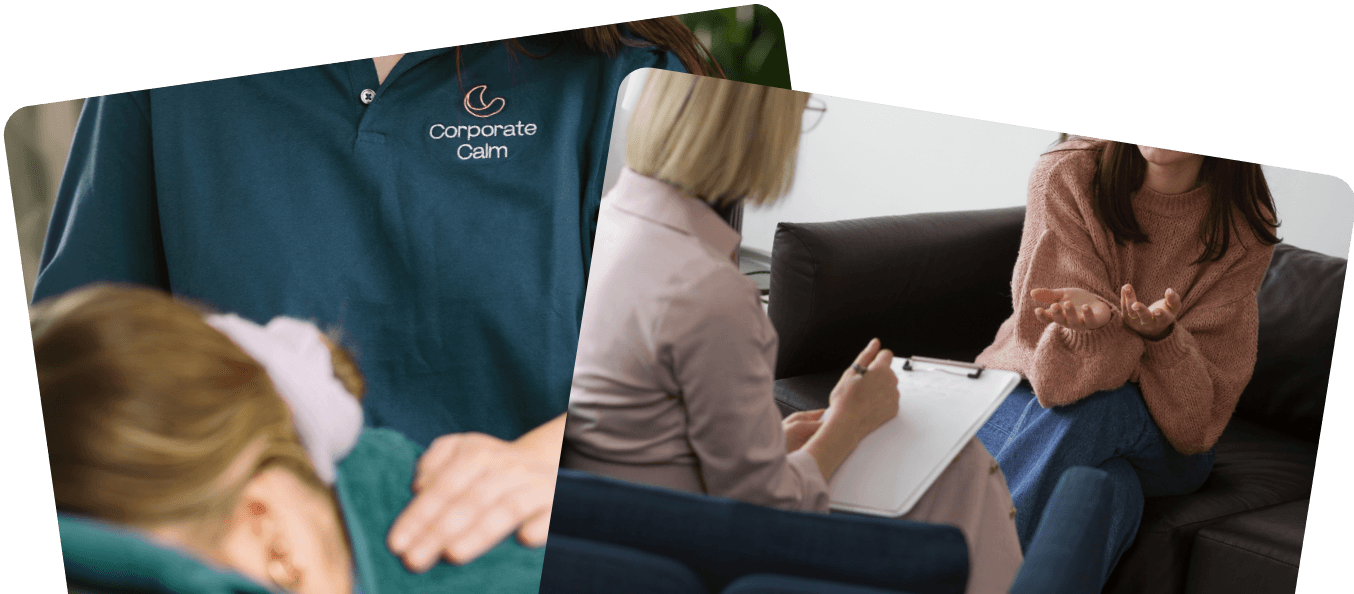
If you're picturing a massage table where you lie face down in your underwear, forget that entirely. Workplace massage uses a specially designed chair that supports you in a comfortable forward-leaning position.
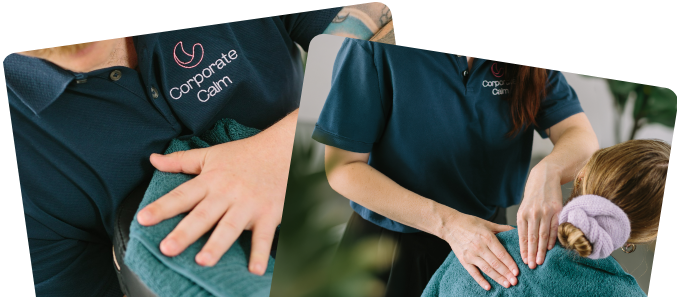
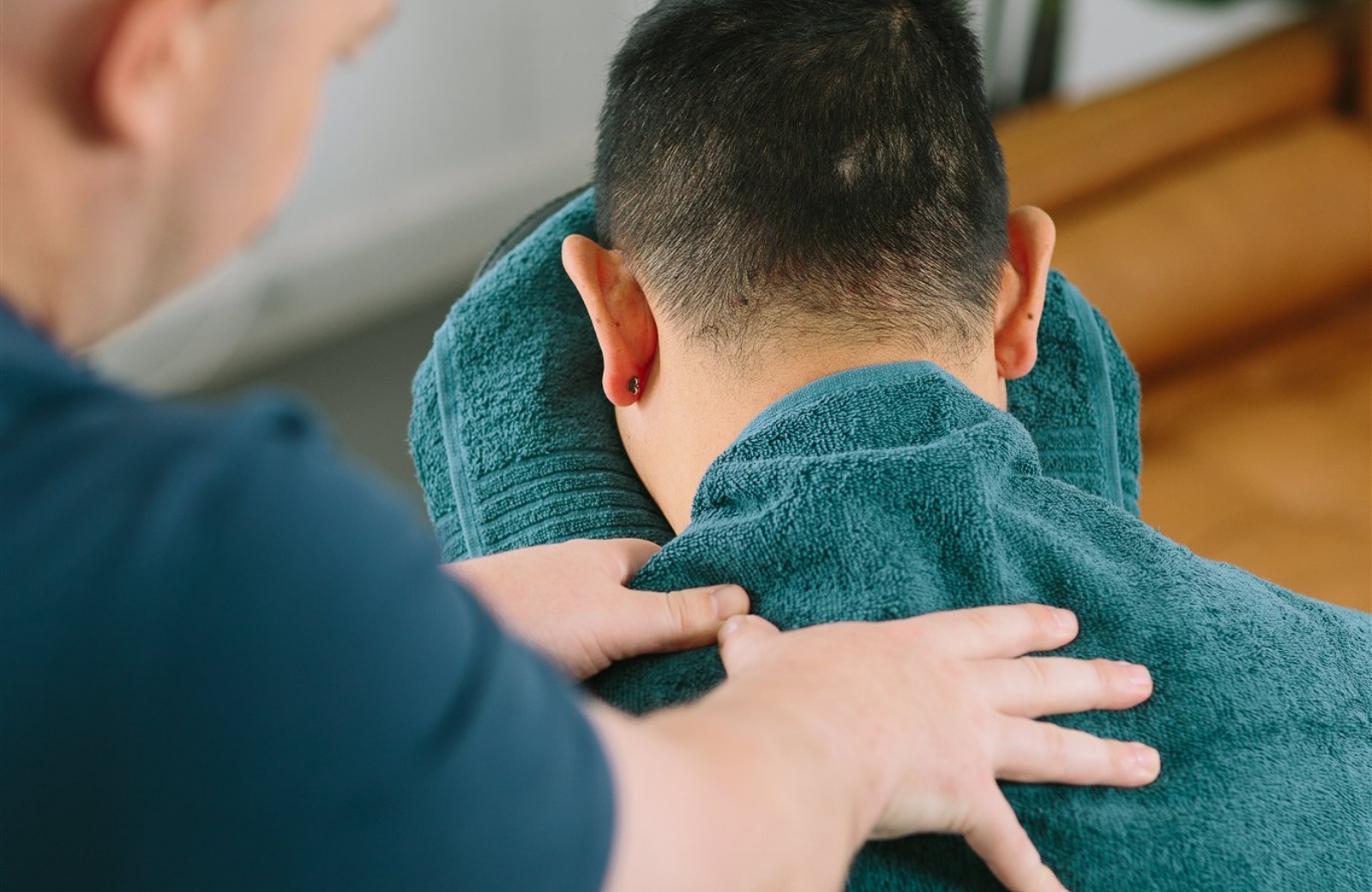
You sit in the chair fully clothed with your face resting in a padded cradle (like a very comfortable donut) and your arms supported on a shelf in front of you. It's ergonomic, it's comfortable and it takes about three seconds to get into position. No climbing, no awkwardness, no one sees you in a vulnerable state.
The chair is brought to your workplace by the therapist. It sets up in minutes and takes up about as much space as an office chair. Your employer will usually designate a quiet corner, a meeting room or a breakout space for the sessions.

What actually happens during the 15 minutes
Your therapist will introduce themselves, ask if you have any areas of tension or anything they should avoid, and then you're off.
The session focuses on the areas that carry the most workplace stress: neck, shoulders, upper back, lower back and arms. These are the spots that absorb hours of sitting, screen staring and mouse clicking. If you've got a specific problem area (that left shoulder that's been nagging for months, the tension headache that arrives every afternoon) tell your therapist. They'll adjust.
The pressure is firm enough to make a difference but not so intense that you'll be sore afterwards. If you want more pressure, say so. If you want less, say that too. Good therapists check in and adjust. Ours always do.
You don't need to make conversation. You can close your eyes, zone out and enjoy the silence. Or you can chat. There's no wrong way to receive a massage.
After 15 minutes, your therapist will let you know the session is done. You'll stand up, probably roll your shoulders a couple of times and notice that the knot you've been carrying since last Tuesday has loosened. Then you go back to your desk.
That's it. No recovery time, no drowsiness, no need to shower. You just feel better.
The science behind why 15 minutes works
Fifteen minutes sounds short. And if you're comparing it to a 90-minute spa day, it is. But research consistently shows that even brief massage sessions produce measurable physiological changes.
Within 15 minutes, cortisol (your stress hormone) drops. Blood pressure reduces. Muscle tension releases as circulation improves to the areas being worked. The American Massage Therapy Association cites controlled studies showing oxygen consumption, blood pressure and cortisol levels all decreased after 10 to 15 minutes of chair massage.
Studies on employer-provided 15-minute chair massages have found stress reductions of up to 85%, reduced anxiety and improved mood scores. A University of Miami study found that adults who received a 15-minute chair massage showed increased speed and accuracy on math computations, while a control group who simply relaxed in the chair showed no change.
The effects aren't just in the moment either. Regular workplace massage (weekly or fortnightly) has a cumulative effect. The body starts to hold less chronic tension, sleep improves and that permanent knot between your shoulder blades finally starts to let go.

Common questions people ask before their first session
Will my colleagues see me getting a massage?The session happens in a designated space, not in the middle of the open-plan office. Your employer sets up a room or area that gives you privacy. You're sitting upright in a chair, fully clothed. Nobody sees anything unusual.
What if I'm ticklish?The pressure used in chair massage is firm and deliberate, not light and feathery. Most people who consider themselves ticklish have no issues at all with chair massage. If a particular area is sensitive, just say so and your therapist will adjust or skip it.
Can I get a workplace massage if I'm pregnant?Yes. Our therapists are qualified to work with pregnant clients and will adjust their technique and positioning accordingly. Just let your therapist know.
What if I have a back injury or chronic pain?Let your therapist know before the session starts. They'll work around any injuries or conditions and can focus on areas that will help rather than aggravate. If something is outside their scope, they'll tell you honestly.
Do I have to participate?No. Workplace massage is always opt-in. Nobody is going to march you to the chair. But we'll say this: 99% of employees who are offered workplace massage choose to participate. Most of the hesitation disappears after the first session.
How often should I get a workplace massage?That depends on your stress levels and your employer's program. Weekly sessions deliver the strongest cumulative results. Fortnightly is still effective. Even monthly sessions make a noticeable difference. The most common feedback we hear is "can we do this more often?"
What happens after your first session
You go back to work. But the afternoon feels different.
That tension headache that usually arrives at 3pm doesn't show up. Your shoulders sit a little lower. You're slightly more patient with the email that would normally make you clench your jaw. The afternoon slump still happens, but it's gentler.
Some people feel an immediate energy boost. Others feel deeply relaxed and a little dreamy for the first 10 minutes before their focus sharpens. Both responses are normal and both mean it's working.
By the end of the day, you'll probably do two things: tell a colleague they should have signed up, and ask when the next session is.

Your workplace massage checklist
Here's everything you need to do before your first session:
Turn up. That's it. That's the list.
Your therapist brings the chair, the skill and the experience. Your employer handles the scheduling and the space. All you need to do is sit down for 15 minutes and let someone take care of the tension you've been ignoring.
Want to know more about how workplace massage works for your team? See how we set it up or grab our free 3pm Slump Survival Kit for 15 more ways to fix workplace exhaustion.